
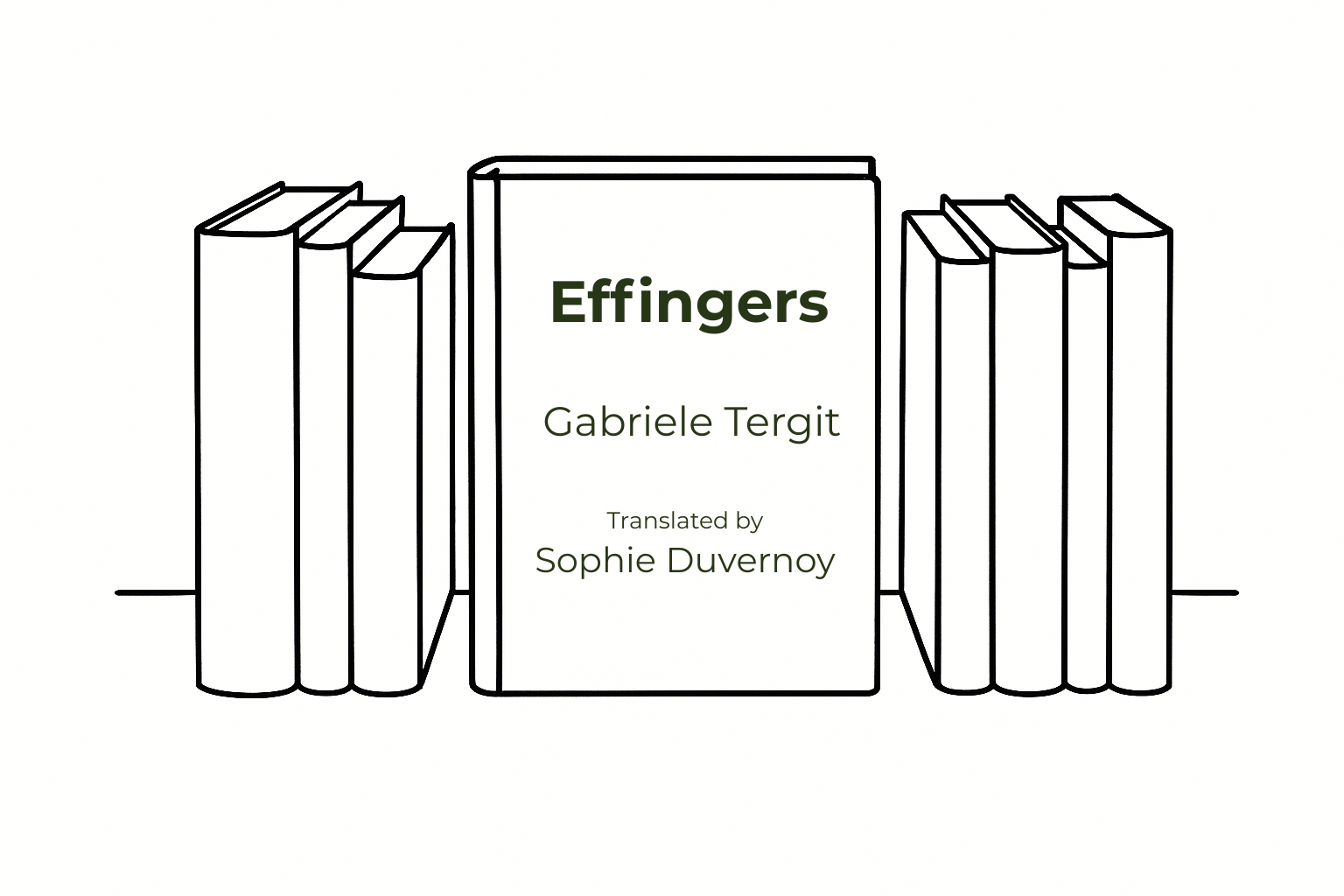
More than seventy years after its original publication in Germany, The Effingers by Gabriele Tergit reaches English readers for the first time. Pushkin Press published the novel in the United Kingdom in November 2025 in a translation by Sophie Duvernoy, and in the same month the American edition was published by NYRB Classics. Tergit’s masterpiece was long neglected in post-war Germany and left untranslated for decades until a 2019 revival, sparked by a new German edition, renewed interest in her work.
The Effingers: A Berlin Saga
Set between 1878 and 1948, The Effingers follows three interlinked Jewish-German families, the Effingers, Goldschmidts and Oppners, through the upheavals of modern German history. From provincial beginnings to the cafés and drawing rooms of Berlin, the novel traces how ambition, assimilation and faith are tested by industrialisation, war and the slow rise of antisemitism.
Often described as a Jewish Buddenbrooks, The Effingers is both intimate and panoramic, a portrait of ordinary lives shaped by extraordinary times. Its short, fast-moving chapters and sharply drawn dialogue reflect the author’s background as a court reporter, bringing to fiction the precision and wit of Weimar journalism.
A Work of Disturbing Truthfulness
Since its rediscovery, The Effingers has been recognised as one of the great social novels of the twentieth century. The Süddeutsche Zeitung called it “a work of disturbing truthfulness”, noting that “no other novel rescues the lost Berlin and the world of Jewish Berliners like this one.” The Frankfurter Rundschau praised how “the author has captured a vanished world for future generations,” while the Der Tagesspiegel described it as “a blend of page-turner and the highest literary quality.”
In the English-speaking world, critic Paul Reitter wrote that Gabriele Tergit’s multigenerational family saga The Effingers possesses “epic sweep, psychological depth and linguistic brilliance”, calling it “a remarkable book, full of insights and characters that make a lasting impression.”

Chronicler of Vanished Worlds
Born Elise Hirschmann in Berlin in 1894, Gabriele Tergit first made her name as a court reporter for newspapers such as the Berliner Tageblatt. Her debut novel Käsebier erobert den Kurfürstendamm was published in 1931 and offered a sharp portrait of media frenzy and urban life in late Weimar society.
After the rise of National Socialism in 1933, she fled Germany, living in Prague and then in Palestine before settling in London in 1938, where she continued to write and worked for the German-speaking section of PEN. It was during these years in exile that she completed the manuscript that would become The Effingers, drawing on her own family background and the social world she had known in Berlin. By the time of her death in 1982, she had become a chronicler of vanished worlds and an important voice among German authors writing in exile.
The Revival of a Long-forgotten History
When The Effingers first appeared in 1951 it received warm critical attention yet struggled to find readers in post-war Germany, where publishers were unsure how to present a large novel about Jewish life at a time when the public mood remained unsettled. For decades it slipped out of print and remained untranslated, known only to specialists and to a small circle of readers who kept Gabriele Tergit’s reputation alive.
Interest returned in 2019, when Schöffling and Co. published a new German edition with an afterword by Nicole Henneberg, prompting major newspapers to reassess the book’s ambition and historical value. This revival laid the groundwork for the first English publication of The Effingers, allowing the novel to re-enter the literary conversation more than seventy years after its debut.
Sophie Duvernoy: Tergit’s English Voice
The English edition of The Effingers is translated by Sophie Duvernoy, a scholar of Weimar literature whose work bridges academic research and literary translation. Her earlier translation of Tergit’s novel Käsebier Takes Berlin introduced English readers to Tergit’s sharp, satirical voice and was shortlisted for the Schlegel-Tieck Prize.
Duvernoy’s background in German cultural history makes her an apt guide to Tergit’s world, where the rhythms of courtroom reportage and the pace of urban life shape the novel’s style. In this new translation she preserves the clarity, humour and emotional range of the original, allowing the novel’s many scenes and voices to emerge with vivid immediacy for contemporary readers.The arrival of The Effingers in English marks the restoration of a major work of European literature. For decades the novel survived quietly in Germany, appreciated by critics yet unknown to wider audiences. Its publication now brings Tergit’s vision to readers, offering a portrait of ambition, belonging and loss that still resonates far beyond its historical setting.
Read also about Ivan Klíma, a long-censored Czech writer in exile, and the quiet English legacy he left behind.