
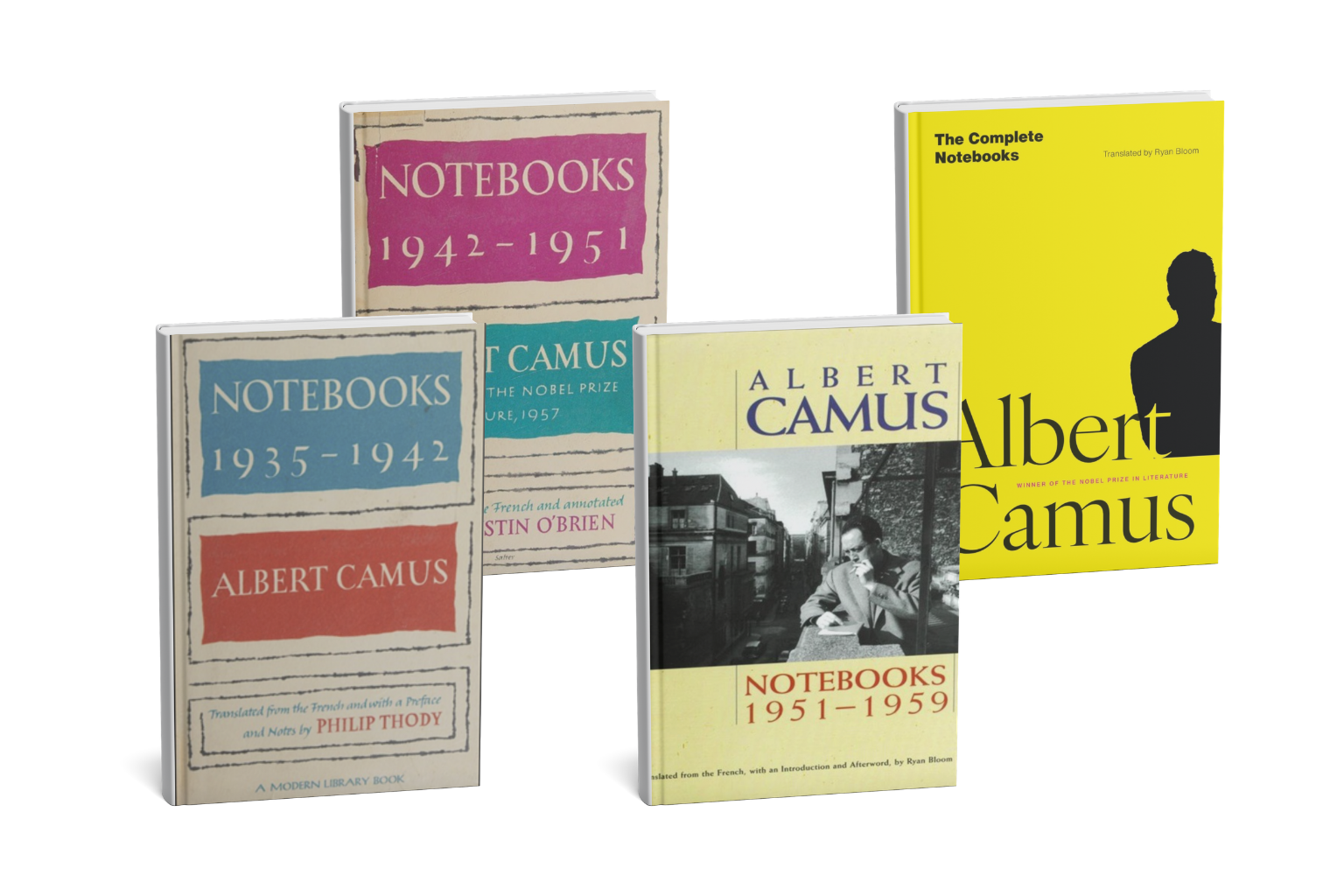
Albert Camus’s notebooks did not arrive as a single, unified work for English readers. They appeared slowly and unevenly, in separate volumes published across six decades. Each was shaped by the translator who carried it into English and by the editorial decisions behind the text. The history of Albert Camus’s notebooks English translation is therefore also a history of mediation.
Only later were Camus’s working notes from 1933 to 1959 gathered into a single volume. Published by the University of Chicago Press and translated by Ryan Bloom, The Complete Notebooks of Albert Camus allow the notebooks to be read as a whole. Seen this way, they offer the most direct record of how Camus thought on the page: outlines for unwritten books, philosophical fragments, private arguments, and images drawn from Algiers and Paris, the war years, and the journeys that shaped his imagination.
This article follows that translation history, from Philip Thody’s first English volume in 1963, through Justin O’Brien’s wartime and post-war notebooks, to Bloom’s 2008 translation of the final cahiers. Reading these versions side by side shows how translation and editing have influenced what the notebooks seem to be: whether a raw workshop, a record of ideas in motion, or a companion text to Camus’s published work.
Philip Thody and the first English notebooks
The first volume of Camus’s notebooks to appear in English was Notebooks 1935–1942, translated and introduced by Philip Thody and published in 1963 by Alfred A. Knopf, with a British edition from Hamish Hamilton. These were the pages Camus began in May 1935, at the age of twenty-two, and kept through the early years of the Second World War.
Thody was already an important British scholar of French literature when he undertook the translation. Born in Lincoln in 1928, he studied French at King’s College London and spent time in Paris before joining the University of Leeds, where he later became Professor of French Literature. His early academic work included studies on Camus, which made him a natural choice to introduce the notebooks to English readers.
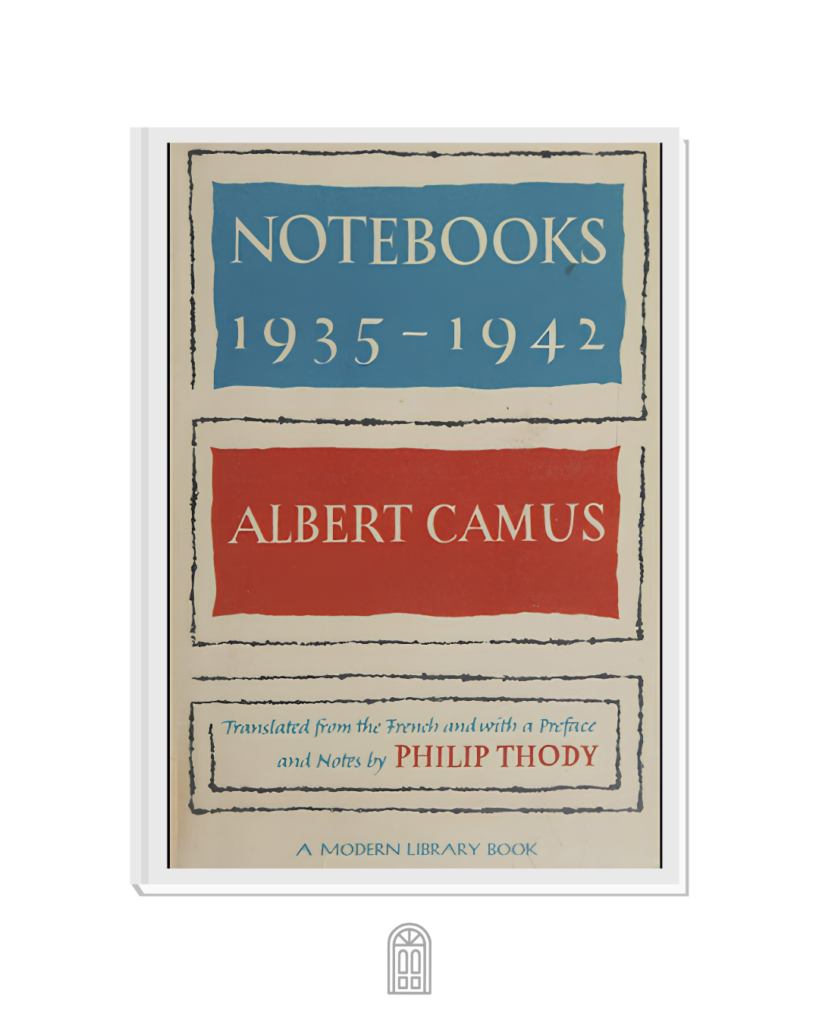
In his preface to the 1963 English edition, Thody explains that Camus’s cahiers began as a series of ordinary school exercise books and were not initially intended for publication. The turning point came in 1954, when Camus produced a typescript of the first seven notebooks and revised it with publication in mind. He removed entries he considered too personal, leaving the early notebooks with remarkably few references to his private life.
Thody also draws attention to the spontaneity of the notebooks. Their physical form, with pencil passages and handwriting characteristic of first-draft thinking, rules out any idea that the entries were shaped through careful rewriting. What appears, he notes, is French in the form Camus originally wrote it. That immediacy guided Thody’s translation, which aims for plainness, directness and fidelity to Camus’s shifting tone.
One of Thody’s most valuable insights is his demonstration of how directly the notebooks fed into Camus’s published work. Several passages from The Stranger, Noces and L’Envers et l’Endroit were written directly into the notebooks and underwent very few changes before being printed. For English readers in the 1960s, this positioned the notebooks as a central document of Camus’s creative life rather than a peripheral record.
Thody reflects on the experience of working on these texts, writing of the pleasure he took in the task, redoubled by the generosity of Camus’s wife, Francine, who allowed him access to the original notebooks and unpublished typescripts.
For decades, Thody’s translation shaped the English-language understanding of Camus’s early notebooks. It established the tone and framework through which these pages were read and set the path for the next major translator of the cahiers, Justin O’Brien.
Justin O’Brien and the notebooks, 1942 to 1951
After Philip Thody’s edition of the early cahiers came the second instalment in the English translation history of Camus’s notebooks. Notebooks, 1942–1951, translated from the French and annotated by Justin O’Brien, was published by Alfred A. Knopf in 1965. Covering entries written between January 1942 and March 1951, the volume spans a period in which Camus published some of his most influential works, from the novel The Stranger and the essay The Myth of Sisyphus in 1942 to The Plague, The Rebel and several of his major plays in the years that followed.
Justin McCortney O’Brien was an American scholar and translator born in Chicago in 1906. He taught French for many years at Columbia University and became known for his translations of modern French literature. Alongside Albert Camus, he translated writers including André Gide and Jean-Paul Sartre, helping introduce major twentieth-century French literature to English-language readers.
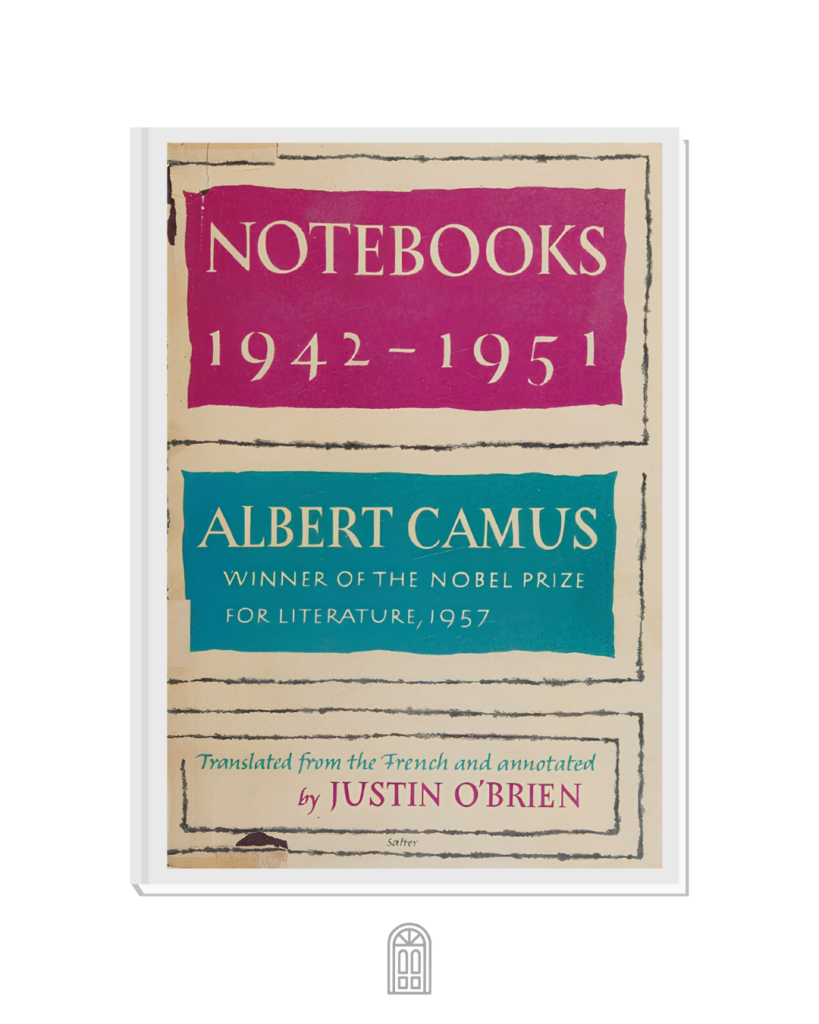
The French text that O’Brien worked from had been carefully reconstructed before publication. It drew on an uncorrected typescript, an earlier typescript corrected by Camus, and the original handwritten notebooks. Some names and passages had been omitted or restored during the preparation of the French edition, which meant O’Brien was translating a text shaped by earlier editorial decisions rather than a single definitive draft.
O’Brien’s edition of the 1942–1951 notebooks appeared at a time of growing interest in Camus among English-language readers. By the mid-1960s, O’Brien had already translated several of Camus’s major works, including The Myth of Sisyphus, The Fall, Exile and the Kingdom and Resistance, Rebellion, and Death, establishing him as one of Camus’s principal English translators. His translation of the middle notebooks therefore extended an important body of work that had already introduced much of Camus’s writing to Anglophone audiences.
The entries he translated span a period of intense creative and political engagement in Camus’s life. These years included his work with the Resistance newspaper Combat, the upheavals of the war and its aftermath, and the ideological debates that followed the publication of The Rebel. The notebooks move between aphorisms, literary reflections, travel descriptions and comments on justice, death, revolt and artistic responsibility. For English-language readers, the volume offered a closer view of the intellectual and creative pressures that shaped Camus’s published work.
O’Brien’s translation adopts a restrained and unobtrusive style. His annotations clarify historical references and literary allusions, and the biographical note he appends at the end of the volume provides readers with the broader context of Camus’s wartime and post-war life. Where Thody’s earlier notebooks reveal a young writer working with immediacy and minimal self-correction, O’Brien’s volume reveals a more assured and outward-facing Camus, reflecting on the ethical demands of his time.
For many years, O’Brien’s translation of the 1942–1951 notebooks provided English-language readers with one of their clearest views of Camus’s mid-career thought. It reinforced the view of Camus not only as a novelist of the absurd but also as a thinker grappling with the moral and political dilemmas of the twentieth century.
Ryan Bloom and the later notebooks, 1951 to 1959
The final notebooks to appear in English before the complete edition were Notebooks, 1951–1959, translated by Ryan Bloom and published by Ivan R. Dee in 2008. This volume covers the last decade of Camus’s life, a period marked by public controversy, recurrent illness and sustained reflection on art, politics and moral responsibility.
Ryan Bloom is a literary translator, writer and scholar whose work has focused extensively on Albert Camus and twentieth-century French literature. His translations of Camus reflect close attention to textual transmission and editorial practice. Unlike Philip Thody and Justin O’Brien, who translated Camus’s notebooks in the decades immediately following his death, Bloom approached the material at a greater historical distance, working from the critical Pléiade edition and benefiting from decades of scholarship on Camus’s manuscripts and notebooks.
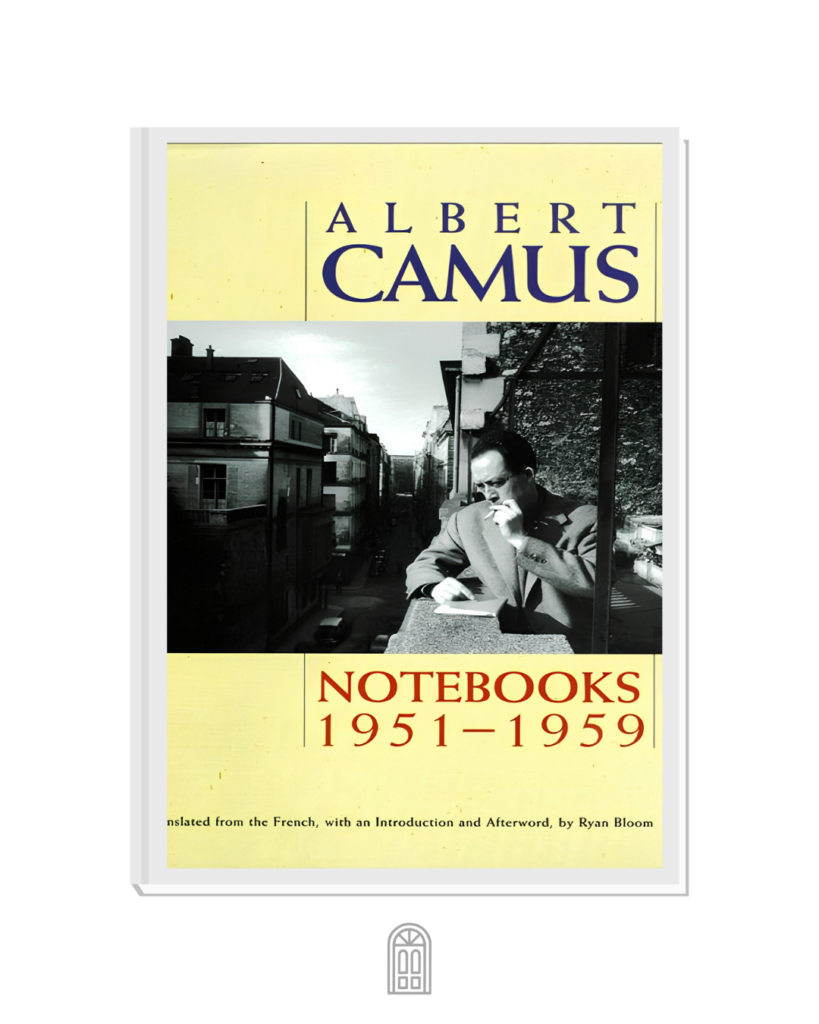
Bloom’s Translator’s Note makes clear that the notebooks from 1951 to 1959 pose distinct challenges. With the exception of Notebook VII, which Camus had partially typed up and corrected during his lifetime, the material Bloom translated was taken directly from handwritten notebooks. Camus’s handwriting is often difficult to decipher, sentences break off mid-thought, and many entries remain fragmentary or ambiguous. Bloom notes that uncertainty is sometimes unavoidable, and he signals doubtful readings explicitly in the text rather than smoothing them away.
His translation philosophy reflects this commitment to transparency. Bloom preserves Camus’s grammatical irregularities, incomplete syntax and abrupt tonal shifts wherever possible, intervening only when readability requires it. Punctuation is added sparingly, and awkward or unfinished passages are left intact. Even quotations are translated as Camus recorded them, rather than being normalised against their original sources. The aim, Bloom explains, is not to refine the notebooks into finished prose but to retain their unpolished character.
The notebooks themselves reveal a Camus increasingly preoccupied with artistic integrity, public misunderstanding and questions of moral responsibility. They contain reflections on the hostile reception of The Rebel, doubts about political engagement and renewed attention to the responsibilities of the writer in a divided world. Bloom’s annotations provide historical and philosophical context for these compressed entries, while allowing their provisional and exploratory nature to remain visible.
For several years, Notebooks, 1951–1959 offered the most direct English-language access to Camus’s final intellectual phase. Bloom later drew on this work in preparing The Complete Notebooks, where the editorial and translational challenges he describes here become central to presenting Camus’s notebooks as a single, continuous body of work rather than a series of separate volumes.
The Complete Notebooks and a single editorial vision
Published in a single volume, The Complete Notebooks brings together Camus’s cahiers from 1933 to 1959 for the first time in English. Read continuously, they form a long intellectual record rather than a set of isolated fragments, allowing Camus’s thinking to be followed from his youth through the war, public recognition and his later years.
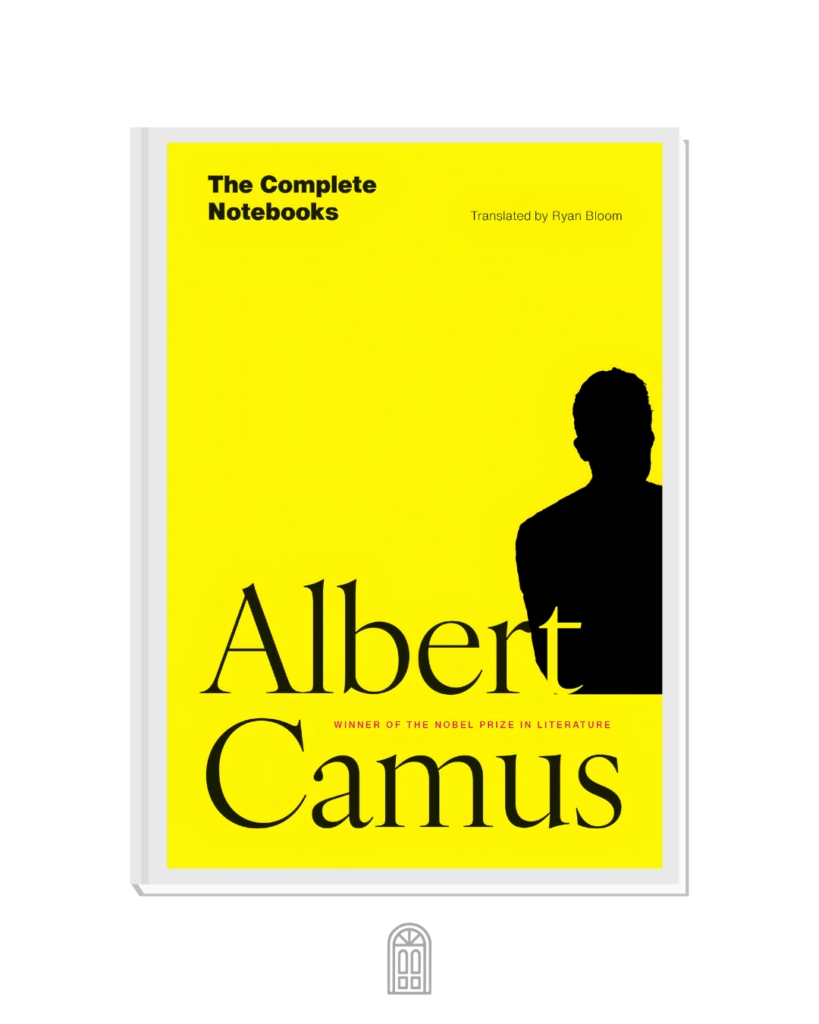
Ryan Bloom’s contribution to this edition lies in providing a consistent editorial and translational approach across the complete notebooks. Having already translated the final notebooks, he approaches the project with editorial restraint that preserves revision, incompleteness and repetition. The notebooks are presented as a working space, not as a retrospective statement shaped into coherence after the fact.
Critical responses have reflected both the difficulty and the rewards of reading the notebooks as a whole. In The New York Times, Dwight Garner describes them as “dense and inward-facing,” comparing the experience of reading them to “panning for gold” before concluding that sustained attention is rewarded by moments of striking clarity. Writing in Literary Review, Joanna Kavenna praises the notebooks’ “brilliant writing – febrile, passionate, moving” and highlights the persistence of Camus’s voice across different forms and ideas. In Open Letters Review, Steve Donoghue commends Ryan Bloom’s “careful, enormously respectful curation” of material that Camus revised over decades, calling the edition “bottomlessly hypnotic.”
Read together, the notebooks reveal patterns that are less visible in separate volumes. Images recur, ethical questions return, and the problem of the writer’s responsibility is revisited across decades. The early cahiers gain depth when set beside the later notebooks, while the final entries appear less as a conclusion than as a continuation of concerns that run throughout the notebooks.
The complete edition also reshapes the place of earlier translations. Philip Thody’s emphasis on immediacy, Justin O’Brien’s annotations and contextual framing, and Bloom’s attention to textual difficulty now form a single arc rather than three parallel approaches. Seen together, they mark the changing ways Camus has been translated, edited and understood in English.
Rather than closing arguments about Camus, The Complete Notebooks keeps them open. What the volume offers is sustained access to the workshop itself, where thought remains provisional and revision never quite ends.